Weekly Briefing: Fintech & Regulated
Week of 29 October to 5 November 2026 Fintech, crypto, web3, prediction markets, gaming, compliance-heavy.
Regulated & Fintech
Fintech, crypto, web3, prediction markets, gaming, compliance-heavy.
Weekly Briefing: Regulated financial infrastructure, digital assets, payments, gaming and emerging markets.
Week of 29 October to 5 November 2026
1. Buys & Sells
Seven moves this week across payments, digital identity, tokenised markets and sports betting, alongside a proposed $350m public-market transaction and an $80m funding round. The common thread is access: customers, licences, infrastructure and the right to operate in regulated markets.
| Date | Buyer / investor | Seller / target | Asset | Value | Geography | Status |
|---|---|---|---|---|---|---|
| 4 Nov (disclosed) | Yellow Card | GoMoney | Brazilian virtual asset service provider and stablecoin payment infrastructure | Undisclosed | Brazil / Africa | Completed in October |
| 3 Nov | Fourthline + Veridas | Merger | Digital identity, biometrics, KYC, AML and fraud prevention | Undisclosed; up to €65m financing | Netherlands / Spain | Completed |
| 2 Nov | Liberis + Qred | Merger | Embedded lending platform combined with licensed digital bank | Undisclosed | UK / Sweden | Completed following regulatory approval |
| 2 Nov | Bilt | LAVA | Sports loyalty, stored-value, identity and fan engagement technology | $300m | US | Acquired |
| 2 Nov | Clever Advertising | Pickswise | Sports betting picks, odds comparison and audience platform | Undisclosed | US / Malta | Completed |
| 2 Nov | FG Imperii Acquisition Corp. | tZERO | Regulated tokenised securities and digital asset market infrastructure | $350m pre-money valuation | US | SPAC merger signed |
| 29 Oct | Intercontinental Exchange (ICE) | Trade[XYZ] | Hyperliquid-based perpetual futures market infrastructure | Undisclosed strategic investment | US | Agreement signed; regulatory approvals required |
Additional financing: Pliant raised $80m in a Series C led by Seaya Nova and Speedinvest on 4 November. The commercial payments platform says it has surpassed $100m ARR after three consecutive years of doubling its business. It plans to expand in North America and open its infrastructure to AI-powered payment applications.
Still live: OppFi withdrew its regulatory applications for its proposed $130m acquisition of BNCCORP and BNC National Bank on 3 November. The merger agreement has not been reported as terminated, but the bank acquisition has hit a significant regulatory obstacle. Global Payments has also been the subject of reported private-equity interest, although there is no confirmed transaction to include in the deal count.
2. What It Means
The interesting thing about this week's deals is that very few buyers are simply purchasing another product. They are buying the difficult bits around it: permission to operate, established distribution, trusted customer relationships and infrastructure that takes years to reproduce. Again, this echos the same theme we are seeing across M&A this year.
The technology is mostly now the easy part. Getting it accepted by a bank, regulator, exchange or customer is another matter.
What are buyers after?
Yellow Card has bought its way into Brazil. Fintech is huge in Brazil largely due to inflation and interest rates. Most consumers are hungry for modern products that help them manage their money well. GoMoney applied to the Banco Central do Brasil for full authorisation, but approval remains pending. It continues to operate under the transitional regime.
The attraction is not just another crypto company. GoMoney gives Yellow Card an established local operation, with the ability to support collections and payments in Brazilian reais, including through Pix, with stablecoin settlement. Yellow Card already has a payments network across Africa and other markets. Brazil gives it a direct foothold in Latin America's largest economy and will allow it to work the Africa - Brazil corridor.
Liberis and Qred have taken a different route to a similar destination. Liberis has spent years building an embedded finance business through partnerships with platforms that already serve small businesses. Qred brings a Swedish banking licence, deposits and lending infrastructure. The combined group now serves more than 60,000 small businesses across 17 countries, with access to around 11.5 million merchants.
A bank can lend money, but it may struggle to reach customers efficiently. An embedded finance platform can reach those customers, but it does not necessarily have the balance sheet or regulatory permissions to provide every product itself. Put the two together and you have a much more interesting proposition.
Fourthline and Veridas are doing something similar in identity. Fourthline has built compliance and decisioning technology for regulated financial services. Veridas brings biometric, document and voice verification. Their merger creates a platform operating across more than 50 countries, with projected combined revenue above €50m in 2026 and a target of €85m ARR by 2029.
The deal includes up to €65m of funding from existing shareholder Finch Capital, new equity from Seaya Andromeda and debt financing from Ashgrove Capital. The businesses expect €20m in annual run-rate synergies, largely through selling each other's technology to existing customers.
There is a practical reason for this consolidation. A bank expanding into another country does not want to assemble a new collection of identity providers, compliance systems and fraud tools every time it enters a market. It wants one supplier that can get it through onboarding without creating another regulatory headache.
ICE is making a rather different bet. The owner of the New York Stock Exchange has agreed to become the exclusive operator of Trade[XYZ]'s proposed regulated US perpetual futures markets, built on Hyperliquid infrastructure, and is making a strategic investment in the business.
The proposed market is intended to offer retail traders around-the-clock exposure to crypto, equities, commodities and foreign exchange through perpetual futures. ICE brings exchange operation and clearing expertise; Trade[XYZ] brings the market design and its relationship with Hyperliquid.
This is not ICE buying Hyperliquid, and the proposed market still needs regulatory approval. But it is another significant acknowledgement that the infrastructure being developed in crypto-native markets is worth integrating.
Where do we still see value?
The first opportunity is in local financial infrastructure. Every market has its own payment rails, banking relationships, licensing requirements and operating conventions. International payment businesses can spend years building these networks. Acquiring a smaller local provider can be a much quicker route and we still see license hunters sniffing around a while longer - particularly in markets where the licensing can move slowly and local knowledge provides an edge.
The second opportunity is identity and compliance. The Fourthline and Veridas combination is unlikely to be the last. There are still plenty of specialist providers in document verification, biometric authentication, AML monitoring, KYB, fraud prevention and transaction surveillance. Some are too small to build a global business independently, but they could be valuable additions to a larger platform.
The third is market infrastructure for digital assets. ICE's move shows that established exchanges are prepared to work with crypto-native technology. That creates opportunities for businesses supplying custody, clearing, collateral management, surveillance, risk systems and market data. The exchanges may attract the headlines, but the less visible infrastructure is where a lot of the acquisition opportunities could sit.
Gaming offers another version of the same story. Clever Advertising has acquired Pickswise, which attracts around 1.4 million visits a month. Clever was already working with the brand on content and marketing before buying it outright. It now owns an audience that it previously helped monetise.
Bilt's $300m acquisition of LAVA is also worth watching. LAVA brings relationships with 56 professional sports franchises and more than 300 technology adapters, alongside loyalty, stored-value and fan engagement systems. Bilt is buying a network of relationships and technology that would take considerable time to assemble itself.
Neither deal is a conventional sportsbook acquisition. Both demonstrate the value of owning the customer relationship, the data and the infrastructure around a regulated or commercially valuable market.
How is value moving?
Towards businesses that sit between the customer and the regulated service.
A stablecoin issuer needs local payment partners. A bank needs identity and compliance systems. An exchange needs clearing, surveillance and custody. A betting operator needs customers, odds data and payments that work within local licensing rules.
These businesses are not always the most exciting companies in their respective industries, but they can be difficult to replace. That makes them attractive acquisition targets.
There is also a growing distinction between owning technology and having permission to use it. OppFi's decision to withdraw its applications to acquire BNC National Bank is a useful reminder. It had proposed a $130m transaction that would have combined its lending platform with a national bank charter. On 3 November, it said it was withdrawing its applications to the OCC, Federal Reserve and FDIC, citing a lack of clear regulatory standards and an inability to address potential concerns through the application process.
The deal has not been formally described as terminated, but the episode shows that a bank charter is not simply another asset on an acquisition list. Regulators still have to be comfortable with the buyer, the business model and the combination.
The same applies to crypto. ICE can invest in Trade[XYZ], but it cannot simply declare a new regulated derivatives market open. The regulatory process is part of the product.
3. The Data
Capital is still going into fintech and crypto, but it is becoming increasingly concentrated. The more interesting question is not how much money is being raised, but which businesses are attracting it and what investors expect them to own.
| Measurement | What the numbers show | Observed or hypothesis |
|---|---|---|
| Fintech deal volume | 650 fintech deals in Q3 2026, down 46% year-on-year and the lowest quarterly count in more than four years (CB Insights) | Observed |
| Fintech M&A | 230 fintech M&A transactions in Q3, down 32% year-on-year | Observed |
| Fintech funding | $11bn raised in Q3, down 18% quarter-on-quarter; funding is on course for approximately $52bn in 2026 | Observed |
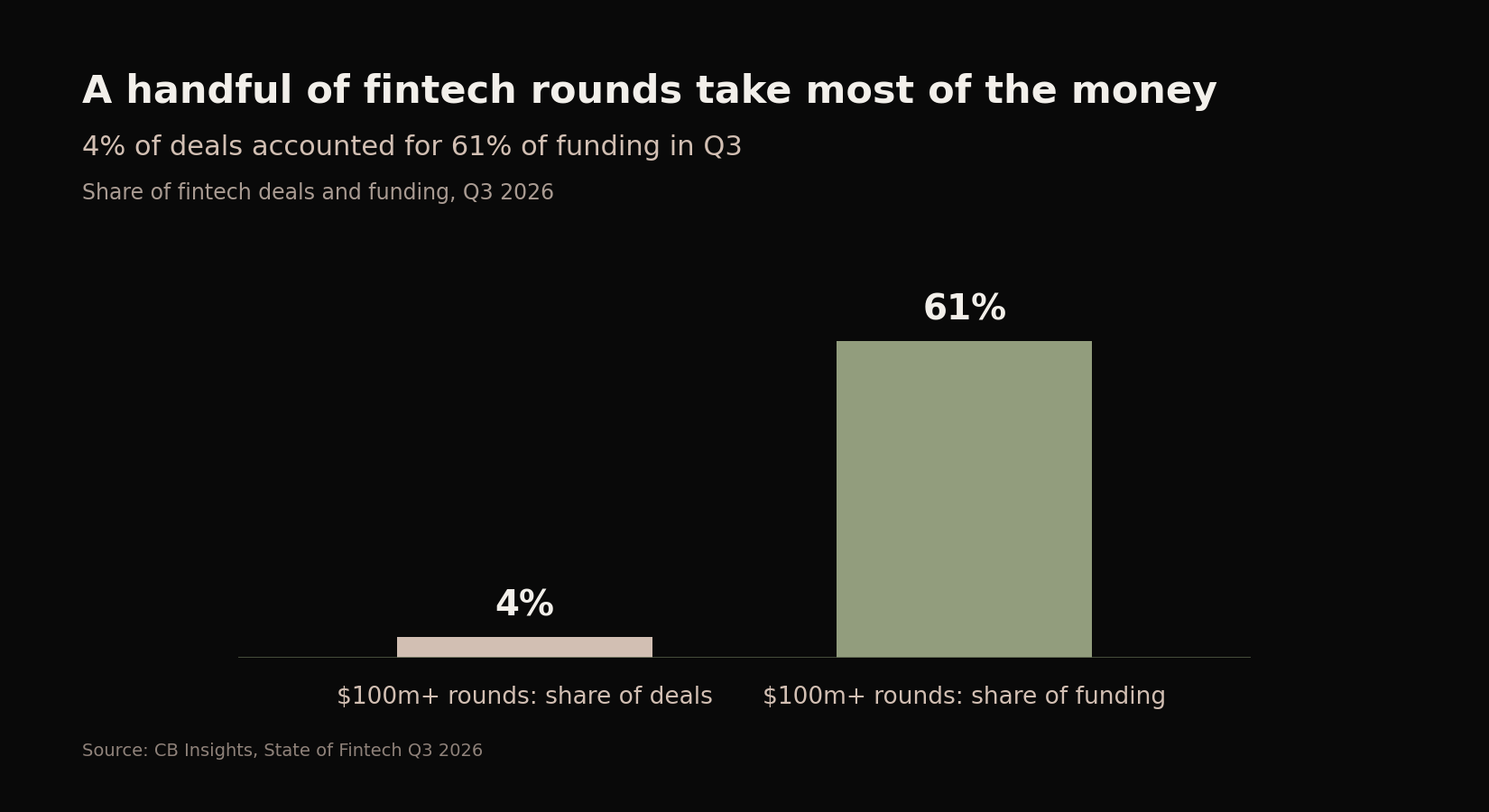
| Capital concentration | $100m+ mega-rounds represented only 4% of fintech deals but 61% of funding in Q3 | Observed |
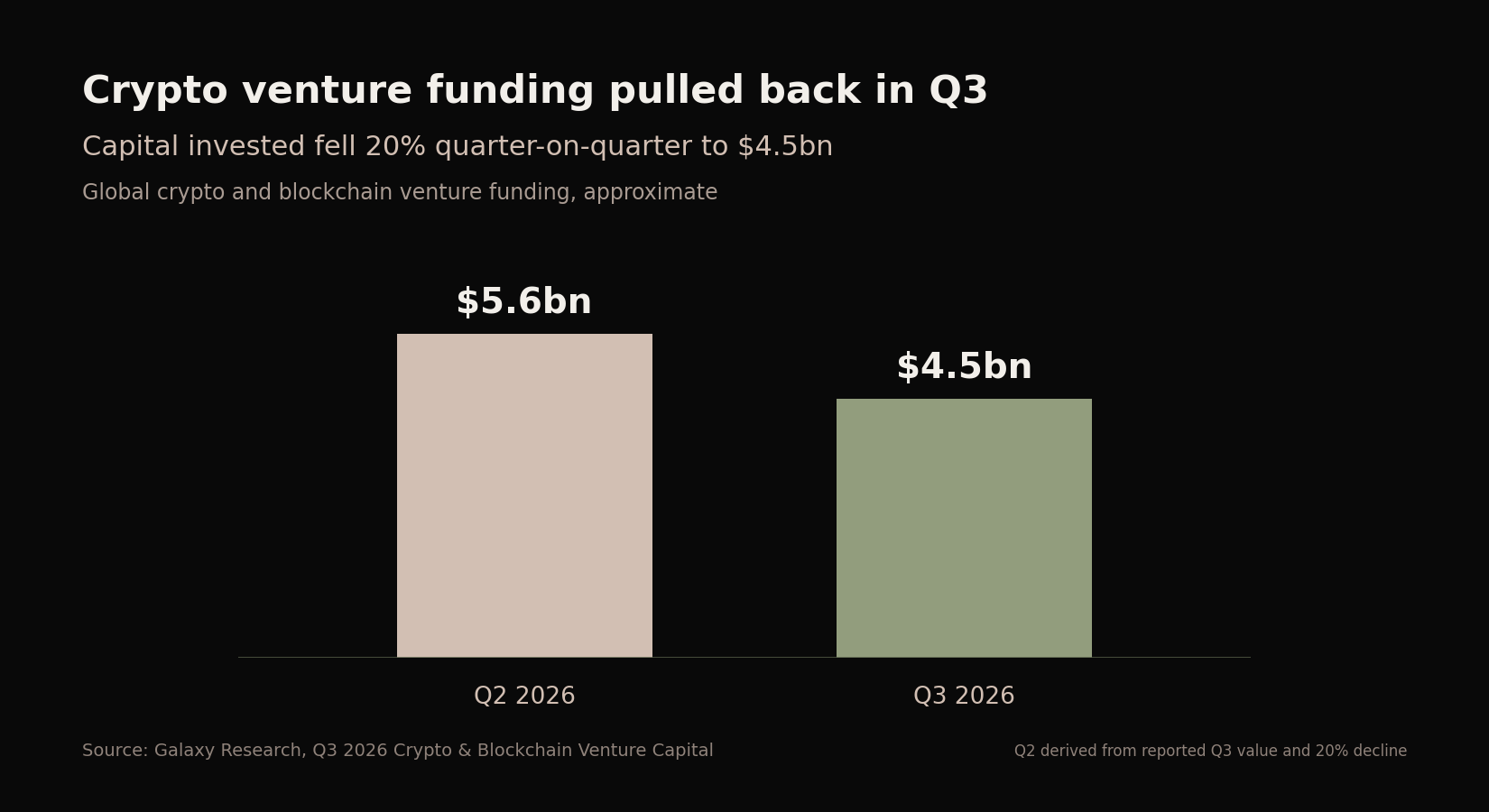
| Crypto venture funding | Approximately $4.5bn invested across 296 deals in Q3, down 20% in capital and 24% in deal count quarter-on-quarter (Galaxy Research) | Observed |
| Prediction markets | Approximately $130bn in notional trading volume across ten tracked venues in October, up 61% on September | Observed; methodology dependent |
| Digital identity | Global identity verification spending forecast to approach $19bn in 2026 and exceed $29bn by 2030 (Juniper Research) | Forecast |
The fintech numbers are worth paying attention to. Deal activity has fallen to its lowest level in more than four years, but the money has not disappeared. It is going into fewer, larger transactions. Mega-rounds accounted for 61% of Q3 funding despite representing only 4% of deals.
That is a market where established companies with distribution, regulatory permissions and meaningful revenue have an advantage. It is also a market where smaller businesses may find it increasingly difficult to raise enough capital to compete independently.
Crypto funding shows a similar pattern. Galaxy Research recorded approximately $4.5bn across 296 deals in Q3, with both capital and deal count falling from the previous quarter. Trading, exchange, investment and lending businesses attracted the most capital, while payments and rewards led by deal count.
Prediction markets are the outlier. October's notional volume across ten tracked venues reached approximately $130bn, up 61% on September, according to Volume Race. Kalshi accounted for around $98bn, or three quarters of the total. Polymarket US recorded approximately $14.8bn.
These are contract volumes, not revenue or cash deposited. They should not be read as the amount of money the platforms earned. Even so, the pace of growth is difficult for traditional exchanges and financial institutions to ignore.
One other number is worth keeping in mind. The combined Fourthline and Veridas business is targeting €85m ARR by 2029, from projected revenue above €50m in 2026. Its expected €20m in annual synergies is a substantial part of the investment case. This is what consolidation can do when two businesses have complementary customers and technology rather than simply overlapping products.
The pattern is becoming clearer. Capital is concentrating in companies that already have a route to market, while buyers are looking for ways to combine infrastructure, distribution and regulatory access.
What we might see next
Stablecoins
The next stablecoin acquisitions may have less to do with the tokens themselves and more to do with the local payment businesses that make them useful. Yellow Card's acquisition of GoMoney is a good example. Every country has its own banking relationships, payment rails and regulatory process. A global stablecoin company can build a product in a few months, but it cannot manufacture years of local relationships.
The US is also moving towards a more formal framework. The OCC published its final rules implementing the GENIUS Act on 21 October, with the rules taking effect on 18 January 2027. They cover reserve assets, redemption, custody, capital and risk management, although separate AML and sanctions rules are still to come.
I would expect more acquisitions of local payment providers, licensed virtual asset businesses and stablecoin settlement companies, particularly in markets where cross-border payments remain expensive. The companies with the best local integrations may become more valuable than the companies with the best-known tokens.
Prediction markets
ICE has shown that traditional exchanges are prepared to work with crypto-native infrastructure. Prediction markets are growing quickly, but the regulatory distinction between event contracts, financial derivatives and gambling remains complicated.
The next acquisition opportunities may be in market surveillance, clearing, risk management, data and liquidity provision. The exchanges will get the headlines, but the businesses that make these markets acceptable to regulators may be worth more.
There is also a question of distribution. Sports betting operators already have millions of customers, payment relationships and state-by-state licensing infrastructure. As prediction markets expand, the boundary between the two industries will become increasingly difficult to ignore. I would expect more partnerships, investments and acquisitions involving the technology and customer acquisition businesses that sit between them.
Digital identity and compliance
AI-generated identities and deepfakes are making onboarding harder to trust. Fourthline and Veridas have combined several parts of the identity chain, and I would expect more consolidation among KYC, KYB, AML, biometric verification and fraud prevention providers.
Smaller specialist businesses with strong bank integrations and proven detection capabilities could be attractive bolt-ons. The important distinction will be between companies that can demonstrate lower fraud and fewer false positives, and those simply adding another AI label to an existing product.
As financial institutions expand across borders, the value of identity providers with local regulatory knowledge will increase. A provider that works in 50 countries is a very different proposition from one that has a good product in a single market.
Institutional crypto infrastructure
Custody is becoming a gateway to other financial products. Once a bank can hold digital assets safely within its existing control framework, it can begin thinking about lending, collateral, settlement and financing.
Komainu and First Abu Dhabi Bank completed two-way digital asset transfers through their institutional custody framework this week. The transfers demonstrate that the infrastructure is operational, with future financing applications in view.
I would look for specialist custodians, collateral management platforms, tokenised asset servicing businesses and institutional settlement providers to become increasingly attractive to banks and larger financial infrastructure groups. The next phase is not just holding digital assets. It is making them usable within the existing financial system.
Gaming and betting
Betting operators spend heavily to acquire customers, and the media, data and technology businesses supplying those audiences are becoming valuable assets in their own right. Pickswise is a small example of this. I would look for more consolidation in odds comparison, betting data, affiliate networks, player verification, responsible gambling technology and payments.
The most interesting targets look more like a company that owns a trusted audience, has established relationships with licensed operators and understands the rules in each state because they can be difficult to replicate.
Bilt's acquisition of LAVA also points to a wider opportunity in sports loyalty. Teams have enormous audiences, but the technology connecting those fans to venues, sponsors, payments and local businesses is still fragmented. There is room for more consolidation here, particularly where a platform can turn a fan relationship into a year-round commercial relationship rather than one that exists only on match day.
The bank charter
OppFi's experience is a reminder that regulatory access can be valuable, but it is not something a buyer can assume it will receive simply by signing an acquisition agreement.
There are still opportunities in smaller banks, specialist lenders and regulated financial institutions, particularly where a buyer can bring technology, distribution or a new customer base. But the regulatory process will increasingly determine which combinations are possible.
I would expect more partnerships and minority investments before outright acquisitions, especially where fintech businesses are trying to build a route into banking without taking on the full regulatory burden themselves.
Matterblack view
The most interesting assets in regulated and frontier markets are increasingly the ones that connect everything else. The payment provider with local banking relationships. The identity company that can onboard customers across jurisdictions. The custodian that allows a bank to lend against digital assets. The data business that helps an exchange manage risk.
Technology is becoming easier to buy and build. Permission, distribution and trust remain much harder to manufacture.
For founders operating in these markets, that creates a useful question: are you building a product that somebody else can reproduce, or are you building the infrastructure, relationships and permissions that somebody else would rather acquire?
If you own a business in payments, digital identity, compliance, custody, market infrastructure or regulated gaming, we'd be interested in hearing from you.
Matterblack — confidential conversations around acquisitions, investment and strategic partnerships.