Weekly Briefing: SaaS platforms, marketplaces, data businesses, infrastructure.
Week of 27 October to 3 November 2026 ·
1. Buys & Sells
Twelve deals this week across the US, Japan, South Korea, the UK and Finland, about $150bn on paper. Roughly three quarters of that is one chip company buying another with its own shares.
| Date | Buyer | Seller / target | Asset | Value | Geography | Status |
|---|---|---|---|---|---|---|
| 3 Nov (disclosed) | Solen Software Group | Teletask | Public health software for WIC agencies in 35+ states | Undisclosed | US | Newly disclosed; completion date unconfirmed |
| 2 Nov | Marvell Technology | Lumentum | Lasers, optical transceivers and circuit switching for AI data centres | ~$115bn implied EV, all-stock (4.5 Marvell shares per Lumentum share) | US | Signed; 12–18 months to close |
| 2 Nov | Publicis Groupe | LiveRamp | Identity resolution and data collaboration platform | $38.50 per share cash; ~$2.5bn equity, $2.17bn EV | US / France | Completed under five-year FTC consent order |
| 2 Nov | ITOCHU (via VIC GK) | Dentsu Soken (38.2% minority) | IT services and proprietary enterprise software | ¥215bn (~$1.4bn), ¥2,880 per share | Japan | Tender offer open to 2 Dec |
| 2 Nov | Salesforce | Loops | AI analytics that explains metric changes, folding into Tableau | Undisclosed | US / Israel | Completed |
| 29 Oct | Brookfield (SPV) with Nvidia | Naver AI factory | GPUs and data centre assets at GAK Sejong, leased back to Naver Cloud | Up to $9bn financing plus $1bn Nvidia equity | South Korea | Signed; 55MW live H1 2027, 200MW by 2028 |
| 29 Oct | DoorDash | Instacart | Grocery marketplace and retailer e-commerce software | ~$17bn equity, $65 per share, at least 75% cash | US / Canada / Israel | Signed 28 Oct; close late 2027 to H1 2028 |
| 28 Oct | Macquarie Asset Management (APIF4) | Gabia and KINX | Hosting and neutral interconnection | KRW 53,000 per Gabia share, KRW 190,000 per KINX share | South Korea | Agreed; tender and delisting after approvals |
| 28 Oct | EQT (BPEA IX) vs LY Corp and Bain Capital | Kakaku.com | Price comparison, Tabelog restaurant guide, Kyujin Box jobs | EQT ¥3,683 per share; LY/Bain ¥3,700, or ¥3,720 with KDDI (~$5bn at current bids) | Japan | Contested; EQT offer extended to 12 Nov |
| 27 Oct | Valmet | Tieto (MES business carve-out) | Manufacturing execution software for pulp and paper, installed at ~300 mills; ~€32m revenue | Undisclosed | Finland | Signed; close expected Q2 2027 |
| 27 Oct | Guidewire | hyperexponential | AI underwriting and pricing software for commercial P&C insurers | $1.7bn cash plus up to $400m earn-out | UK target, US buyer | Signed; close by end of January 2027 |
| 27 Oct | Francisco Partners | Weave | Patient engagement and payments software for healthcare practices | ~$650m, $7.40 per share | US | Completed take-private |
Still live: Bloomberg broke the Marvell and Lumentum talks on 28 October, so Lumentum's premium is measured from that day's close. LY Corp says its rival Kakaku.com bid has every clearance it needs and could launch mid-November. That auction isn't done.
2. What It Means
After the so-called SaaSpocalypse, SaaS deals are evening out. The ones getting done have moats made of distribution, relationships and customers.
Earlier this year the market decided AI would eat software. If a model can write the code over lunch, why pay a monthly fee for it? Public SaaS fell to 3.3x revenue by Q2 and plenty of founders started looking at what their company was worth, Matterblack inquiries in SaaS increased by 50%.
This week the buyers paid for the bit a model can't generate, which is the customer list and the trust attached to it.
What are buyers after?
Guidewire runs the core systems insurers live on. It just agreed to pay $1.7bn cash, plus up to $400m more, for hyperexponential, a London pricing platform already sitting inside underwriting on more than $75bn of premium a year. Guidewire could build a pricing tool. Getting Allianz, Aviva and Markel to trust it with their underwriting would take years it didn't want to spend.
DoorDash bought the same thing in grocery. Instacart comes with relationships across 2,200 retail banners and nearly 100,000 stores. Supermarket chains don't sign delivery partners on a whim. Every one of those contracts was a year of meetings for somebody.
Macquarie came back to Seoul with a better offer for Gabia and KINX. KINX runs interconnection, the rooms where networks physically plug into each other. Getting every network that matters into one room takes a decade, and Macquarie would rather pay up than wait.
Kakaku.com runs Japan's biggest price comparison site and owns Tabelog, the restaurant guide Japanese diners check before they book. Japanese consumers lean hard on trusted reviews before they spend, and Kakaku is the company that collects that trust and sells it. Platforms like that almost never come up for sale in Japan, which is how you get a bidding war.
EQT bid ¥3,000 a share in May. Bain and LY Corp, SoftBank's internet arm, came in over the top, and the price has moved at least eight times since. EQT's last raise was ¥1, the bidding equivalent of edging in front of someone at the bar. EQT sits at ¥3,683 and the rival at ¥3,700, about 74% above the ¥2,121 the shares traded at before the talks leaked.
LiveRamp spent years being in a polyamorous relationship, the place where rival ad agencies matched their data without having to trust each other. Then it entered into a monogamous marriage with one of them. Publicis closed its roughly $2.5bn purchase on Monday, and the FTC made it promise to treat everyone equally for five years. Two of the exes aren't buying it: WPP is winding down its use and Omnicom moved its exit forward. The same day, Apple changed the locks and Safari started blocking LiveRamp's identity domains.
Instacart has the same problem coming. Plenty of grocers run their own websites on Instacart's tech, and in a year or two that tech could belong to the company delivering for their competitors.
Where do we still see value?
Follow the people who now feel awkward. Every agency inside WPP and Omnicom needs a new place to match its data. Every grocer on Instacart's software has a reason to take a call. Independent identity and clean-room businesses got more interesting to buy this month, and so did white-label grocery e-commerce vendors. A PE owner can promise neutrality and be believed, which gives sponsors the edge here.
If you run vertical software, check whose partner page you're on. hyperexponential was a Guidewire technology partner before it was a Guidewire subsidiary. In insurance, health and legal, the platform you integrate with is probably your buyer, and every integration you ship is part of your sale process.
Japan and Korea keep throwing up take-privates. ITOCHU is buying out Dentsu Soken's minorities and Macquarie is collapsing the Gabia and KINX double listing. Both markets have spent years pushing companies to stop parking subsidiaries on the exchange at a discount. Every one of those has a controlling shareholder with a reason to move.
How is value moving?
Owning compute and selling compute are becoming two businesses. In the Naver deal a Brookfield vehicle owns the GPUs and the Sejong data centre and Naver sells the capacity. Brookfield gets an infrastructure asset with a long contract. Naver keeps the customer and keeps billions of fast-ageing chips off its balance sheet. Cloud operators across Asia and the Gulf have the demand and lack the balance sheet. Expect them to copy this.
Inside the data centre, money is moving from copper to light. Marvell is paying $115bn in stock for Lumentum because copper can't carry what AI clusters need anymore. A month ago the hot buys were switchgear and cabling. This week it's lasers. The scarce asset keeps moving towards whatever joins the chips together, and anyone making photonics or optical test kit is holding something the big chip groups now need. Cooling, meanwhile, has indeed cooled. Ecolab, Trane and the other big buyers have mostly done their shopping, so expect the next deals to come from optics, power and connectivity.
Waiting is part of the price now. DoorDash will pay Instacart $1.25bn if regulators kill the deal, with an outside date that can stretch to two years. Lumentum expects 12 to 18 months. If you're selling into a concentrated market, expect the buyer to fight over the timeline as hard as the number.
3. The Data
More deals, slightly less money each. The market isn't paying up across the board, so this week's big premiums are about specific assets.
| Measurement | What the numbers show | Observed or hypothesis |
|---|---|---|
| Deal volume | 698 SaaS deals in Q3 2026, 2,083 year to date, running 2.9% ahead of 2025's record pace (SEG). Broader software volume rose 3% quarter on quarter to 603 deals (Berkery Noyes). | Observed: steady, mildly accelerating |
| Deal values | Software transaction value fell 17% quarter on quarter, from $131.2bn to $108.7bn (Berkery Noyes). This week alone carried ~$150bn, most of it in one all-stock semiconductor deal. | Observed for Q3; this week is an outlier. |
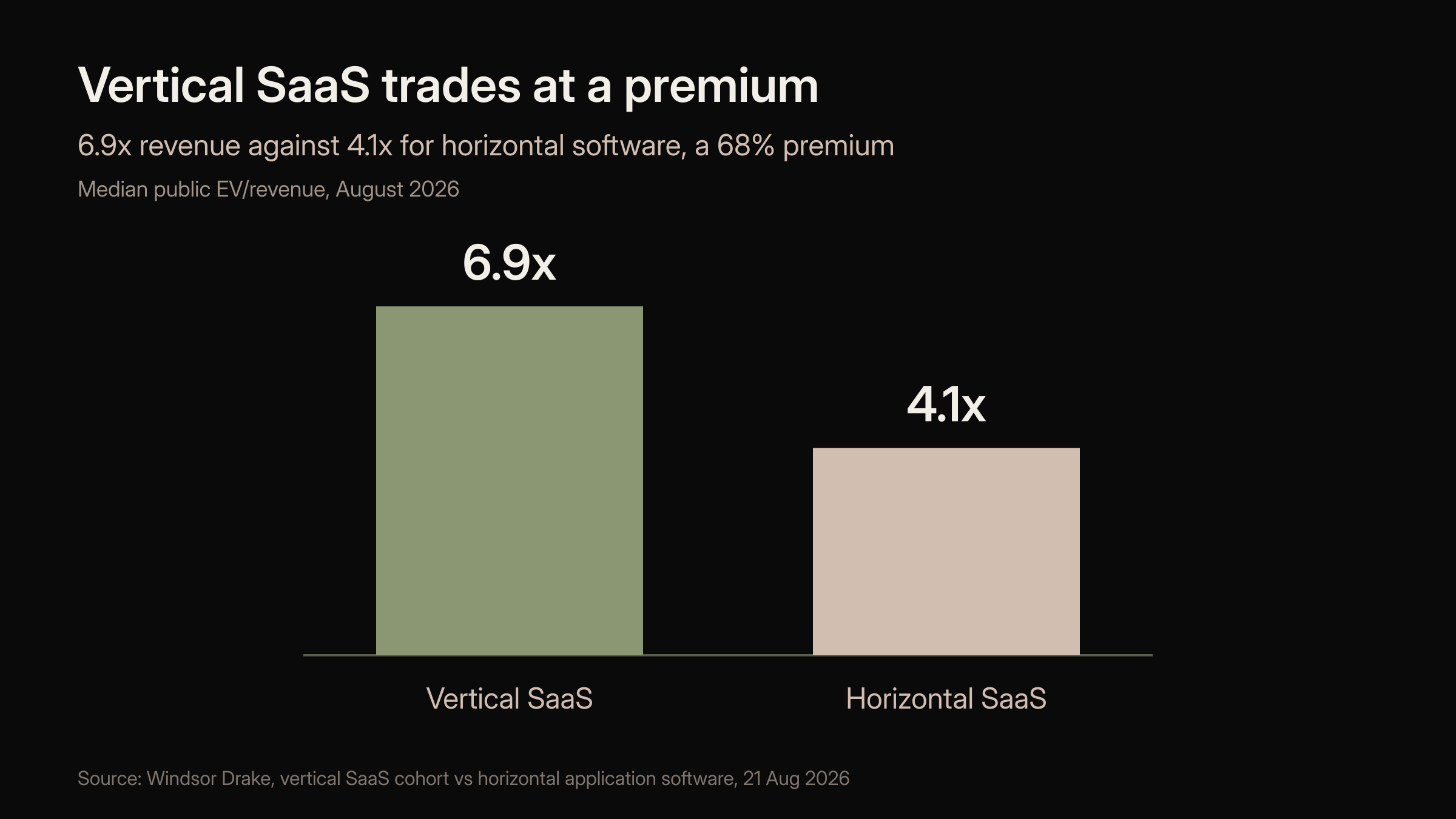
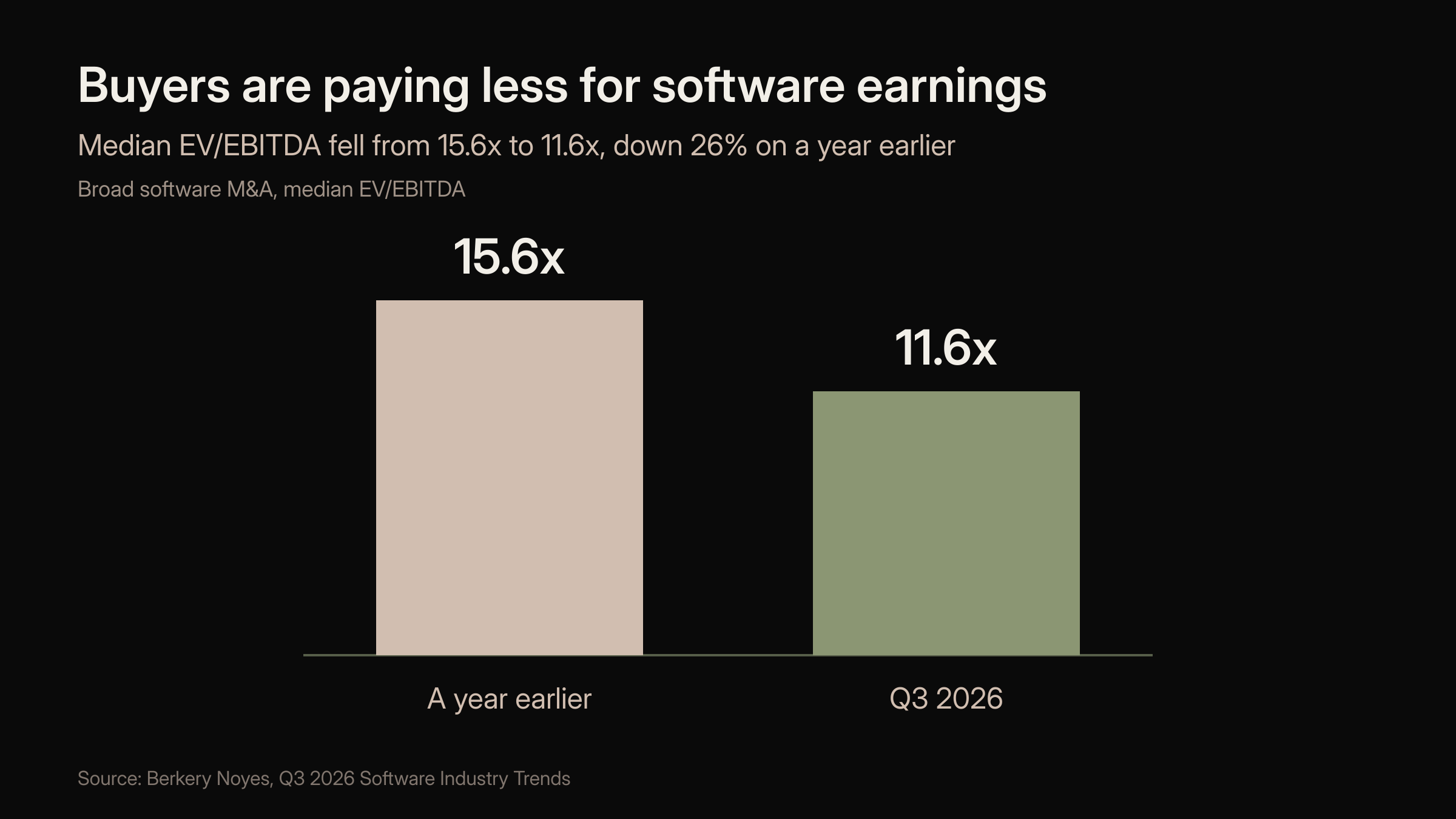
| Valuations | Median software revenue multiple fell from 3.2x to 3.0x year on year and the EBITDA multiple from 15.6x to 11.6x (Berkery Noyes). Public SaaS recovered to 4.1x EV/TTM revenue in Q3 from 3.3x in Q2 (SEG). Against that, one analyst puts hyperexponential at about 21x projected ARR. | Observed: medians compressing while AI-native vertical assets clear far above them |
| Vertical vs horizontal | Vertical SaaS made up 355 of Q3's 698 SaaS deals, with financial services (56) and healthcare (53) the busiest verticals (SEG). Public vertical SaaS trades at a 6.9x median against 4.1x for horizontal (Windsor Drake). | Observed |
| Buyer composition | Sponsors accounted for 24% of software deal volume but only 9% of value in the first three quarters (Berkery Noyes). This week's table splits seven strategic buyers to four financial, with Solen undetermined. | Observed for the year; this week's split is too small a sample to read |
| Seller composition | Seven of the eleven sales were public companies, and one more was a division sold by a listed parent (Tieto's MES unit). The Naver deal is financing, not a sale, so it isn't counted. The private, venture-backed exits were hyperexponential and Loops; Teletask's ownership is undisclosed. | Hypothesis: buying a listed company is the quickest route to scale while private valuations stay sticky |
| Geography | Japan logged 26 deals worth $15.2bn in October, up from two in September on one tracker's count (M&A News). Korea produced two Digital Infrastructure deals this week. | Observed for Japan in one tracker; a single month, so treat as a signal to watch |
| Deal structures | hyperexponential's earn-out is worth up to 24% of its base price. DoorDash's $1.25bn reverse break fee equals about 7% of the equity value. Lumentum is all-stock; Instacart is at least 75% cash; Guidewire is borrowing $1bn to pay cash. | Observed; percentages are Matterblack arithmetic from disclosed terms |
Two things look solid. Earn-outs are becoming more prominent as buyers intuit growth but can't see it yet: nVent and CBRE did it on their infrastructure deals and Guidewire did it this week. And the fattest premium of the week came out of a bidding war in Tokyo. I want one more quarter of data before calling Asia the top-paying market for this vertical.
What we might see next
SaaS
A model can write an insurance pricing engine over a long weekend. Getting that engine signed off by a regulator and somebody’s government security team takes longer with a lot of forms. I think buyers will start paying for the forms, because owning software that’s already approved gets them to market quicker. Pricing is the other mess. Customers are swapping seats for agents, so seat revenue shrinks while usage grows, and nobody has worked out what a dollar of usage is worth yet. Earn-outs tied to usage will fill that gap until somebody does, or until there’s enough data to price it properly. Keep an eye on small vertical vendors too. Plenty of them will sell before an AI-native startup copies them in their own niche, which hands serial acquirers the cheapest pipeline they’ve had in years.
Marketplaces
The biggest threat to a marketplace is customers ghosting it. An AI agent does the comparing and the booking, and the site that used to get the visit gets put in the junk drawer. Discovery was a marketplace’s value, so any marketplace that doesn’t control its supply through contracts or its own warehouses could be in trouble. If I ran a discovery-led marketplace, I’d be taking calls while my traffic chart still points up. Somebody will also buy the dull pipes agents need to spend money, like checkout and returns, rebuilt as APIs for software to call.
Data
The open web is slowly locking its doors. Browsers block tracking and publishers block AI scrapers. Data you own, or have properly licensed, gets more valuable every quarter, especially the unglamorous stuff: trade flows, property records, claims histories, readings off factory sensors. Right now AI companies mostly rent this data. The bigger ones will start buying the landlords, because landlords have a habit of raising the rent. If you run a neutral data business, assume any strategic bid arrives with a firewall stapled to it, and that the sponsor bid will be the easier conversation.
Infrastructure
For a while the shortage was chips. Now it’s electricity, and the dealmaking is following the wires. Expect deals where the prize is a grid connection or a planning consent - the data centre becomes the frame only. Utilities and energy companies could start buying data centre developers, and a few more property developers will try it the other way round. This one’s a guess. AI chips go out of date quickly, and a lot of them were bought with debt. If the next generation lands while that debt is still outstanding, some owners will have to sell compute they can’t refinance. That’s when a used market for AI hardware starts to look like the one for aircraft, with lessors, appraisers and parts dealers all making money off kit somebody else bought new. Whoever publishes the price a three-year-old chip actually fetches will own a very useful number. And when the chips are too old to resell, the copper, gold and memory inside them, plus the cabling around them, become somebody’s recycling business.