Weekly Briefing: AI & Emerging Tech
Week of 27 October to 3 November 2026 Machine learning, automation, quantum, robotics, space, defence, medical, next-gen tech.
AI & Emerging Tech
Machine learning, automation, quantum, robotics, space, defence, medical, next-gen tech.
1. Buys & Sells
Eight moves this week across the US and Japan, led by Thrive's $15.3bn deal for ADT and Anthropic's IPO filing.
| Date | Buyer | Seller / target | Asset | Value | Geography | Status |
|---|---|---|---|---|---|---|
| 26 Oct and 3 Nov | Public markets (IPO) | Anthropic | AI model developer; the 3 Nov amendment shows $895.4bn of committed compute and infrastructure spending | No price set; raise reported at $75bn to $100bn | US | Public S-1 filed 26 Oct; marketing could start week of 9 Nov |
| 2 Nov | Churchill Capital Corp XI (SPAC) | Agility Robotics | Digit humanoid robots for warehouses and factories | ~$465m gross capital; $2.5bn pre-money equity value | US | Approved 2 Nov; closing expected 4 Nov, Nasdaq listing as AGLT 5 Nov |
| 2 Nov | Salesforce | Cresta | Voice AI agents and live coaching for contact centres | Undisclosed; reported $2.7bn | US | Signed; close Q1 of Salesforce FY2028 (Feb to Apr 2027) |
| 30 Oct | Accenture (via Accenture Japan) | Global Security Experts | Cybersecurity services and training | ¥8,500 per share; tender for ~40% worth ~¥51.8bn | Japan | Tender 2 Nov to 15 Dec; top two holders (59.8%) sell via buyback after |
| 29 Oct | Thrive Holdings | ADT | US home security monitoring and installation | $10.00 per share cash; ~$7.6bn equity, $15.3bn EV | US | Signed; go-shop to 28 Nov; close expected Q1 2027 |
| 29 Oct | Salesforce | Rune Technologies | AI logistics software for military supply chains | Undisclosed; reported ~$375m, cash and stock | US | Signed; close expected Q4 of Salesforce FY2027 (by end Jan 2027) |
| 27 Oct | Amazon Leo | Globalstar | Satellite operator, ~25MHz of mobile-satellite spectrum and the C-3 constellation licence | ~$11.5bn reported | US | FCC approved transfer of control 27 Oct; close expected 2027 |
| 28 Oct | Anthropic | Mithril Medicine | One-person biotech with rare muscular dystrophy programmes | Undisclosed | Undisclosed | Completed |
Still live: ADT can shop for a better offer until 28 November. SpaceX is reportedly in talks to buy EchoStar's Boost Mobile or get access to its network.
2. What It Means
Anthropic bought a one-person biotech this week - I found that not everyone in biotech is impressed. The results around Mithril Medicine are preclinical and haven’t been peer reviewed, and one BioSpectrum columnist made the point that a better result in a dish is still only a hypothesis about a medicine. The founder, Cody Tranbarger, used Claude to build much of Mithril, and is quoted as saying “Along the way, what began as an exercise in staying lean evolved into the thesis for an entirely new operating model, which we now call Pipeline-in-a-Person.” Whatever you make of the science, the deal tells founders something useful. If you find a hard enough problem and move on it fast, somebody may pay for it, even when the company is one person and a lot of Claude.
Salesforce, meanwhile, added more firepower to Missionforce, the defence unit it launched in September 2025. It’s a smart move. Global military spending hit a record $2.9tn in 2025, the eleventh year of growth in a row, according to SIPRI. Europe’s rose 14% to $864bn, and NATO members have committed to 5% of GDP on defence and security by 2035. Rune allows Missionforce to be inside Army and Marine Corps systems without waiting years to earn its way in.
What are buyers after?
It’s the same story across most verticals. As AI keeps disrupting industries, buyers are going after the rails that take too long to build (ADT), the way into legacy systems and customers that take years of relationship building (Rune), and people who have found new ways to solve problems (Mithril).
Up in orbit, the scarce thing is spectrum. Amazon is paying $11.5bn for Globalstar mostly for its slice of mobile-satellite airwaves and the right to build a 48-satellite constellation. SpaceX is reportedly talking about buying Boost Mobile, or at least getting onto its network. Sending a signal from space straight to an ordinary phone only works if you own the frequencies, and the people who own them know it.
Where do we still see value?
In the boring bits that touch the real world and that a model company can’t spin up quickly (logistics software already certified to run on a military network, contract labs running experiments for the new AI-run biotechs). The buyers are now proving they’ll pay for them.
Robotics founders should read the Agility numbers carefully. Churchill’s trust was expected to hold about $424m before redemptions and ended up delivering about $164m, so roughly six in ten SPAC investors took their money back. The $201m PIPE led by Foxconn was the biggest single piece of the ~$465m raised. Strategic investors who build things believe in humanoids more than public investors do right now, and that points robotics exits towards manufacturers and logistics groups.
How is value moving?
Towards the AI companies with the biggest cheques, and at whatever pace the regulator allows on anything touching spectrum (Globalstar).
3. The Data
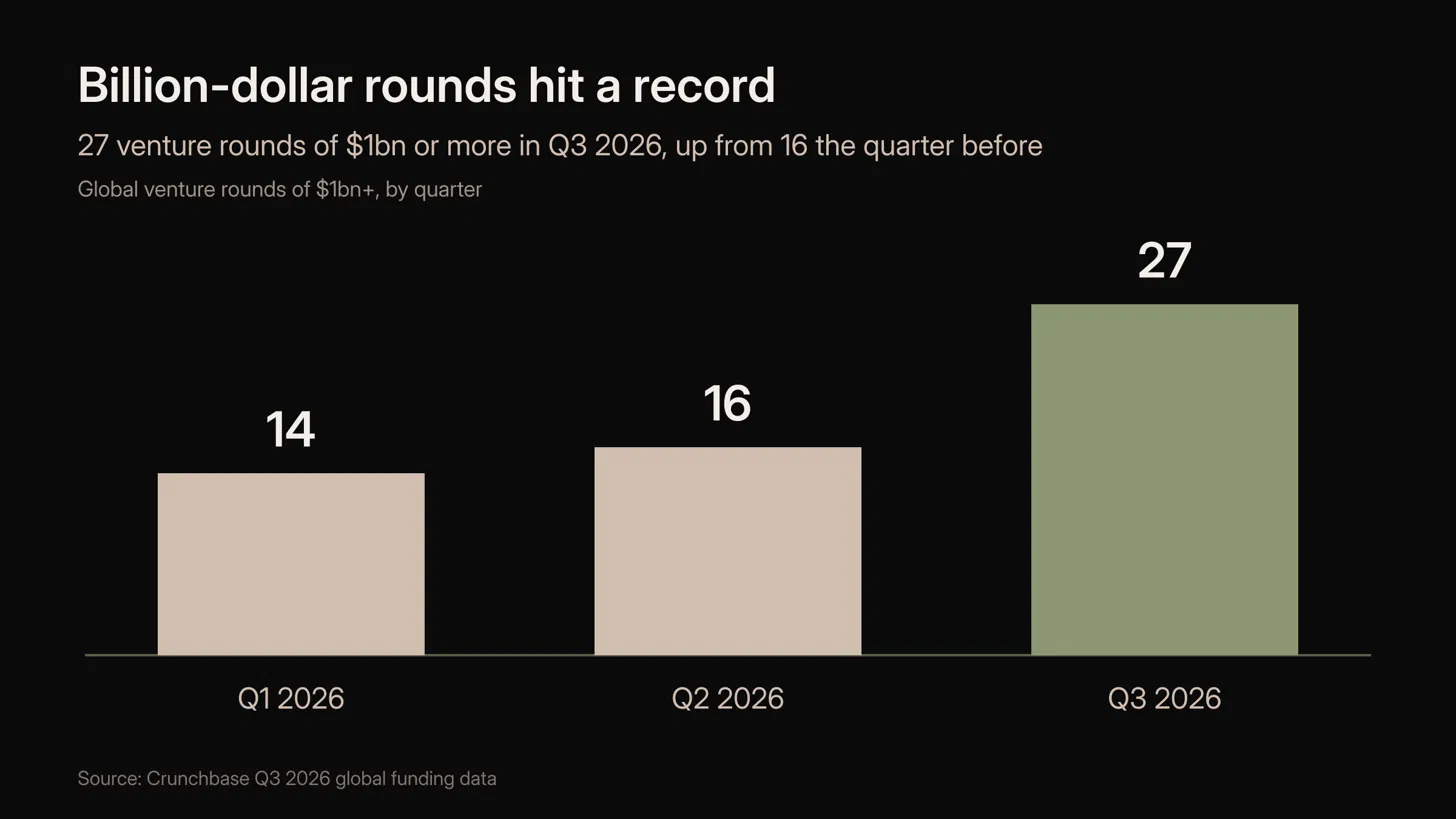
The money is concentrating. More of it is going out in billion-dollar cheques, and AI companies are using it to buy each other.
| Measurement | What the numbers show | Observed or hypothesis |
|---|---|---|
| Deal volume | AI companies bought 195 other AI companies in 2026 to 29 September, 14% more than in all of 2025. The number of distinct buyers rose only 2%. | Observed: repeat buyers are driving the count |
| Capital | Global venture funding reached $159bn in Q3, and AI took $102bn of it, or 64%. | Observed |
| Deal values | Q3's largest AI deals were Nvidia's $12.9bn bid for Hugging Face, AMD's $8.2bn move for World Labs and Stripe's $7.5bn purchase of OpenRouter. This week's ~$30bn is about half Thrive and ADT. | Observed; this week is lumpy |
| Valuations | ADT's buyer paid a 45.6% premium. Agility listed at a reported ~$2.5bn. | Observed |
| Buyer composition | Five of this week's eight moves were strategic acquirers (Salesforce twice, Accenture, Amazon, Anthropic). One was an AI-backed holding company, and two were public-market events. | Observed; one week is a small sample |
| Seller composition | Four targets were venture-backed (Cresta, Rune, Mithril, Agility). Three were listed (ADT, Global Security Experts, Globalstar). | Hypothesis: venture-backed AI firms are choosing strategic sales over a listing queue that the mega IPOs will dominate |
| Geography | Six of eight moves were US-led and one was in Japan. Mithril's location wasn't disclosed. No European AI or deep-tech target changed hands this week. | Observed for one week |
| Deal structures | About six in ten Agility SPAC investors redeemed, leaving ~$164m of an expected ~$424m trust, and a $201m Foxconn-led PIPE filled the gap. Rune won't close until late 2027. | Observed; redemption share is Matterblack arithmetic |
One pattern already looks solid. The companies building the biggest models are now the busiest buyers of smaller AI companies. The other is a hunch I'd want more evidence for: public investors are cooler on robotics than the manufacturers writing the PIPE cheques, and one SPAC isn't enough to call it.
What we might see next
AI agents
As more and more agent-led products come across my desk, I keep asking myself when building AI agents gets its “App Store moment”. In other words, when does the complexity get stripped away, so everyone has agents handling more of their daily tasks and admin? My guess is it’s imminent, and with it comes the need for connectors that let those agents actually act. Right now the systems of record live in walled gardens. So do the walled gardens buy or build the agents, or is it the other way round? My bet is the walled gardens. Independent agent companies with good products and no system of their own will mostly end up as features inside somebody’s suite. The survivors will own a workflow nobody else has digitised yet, and pricing will drift towards paying per resolved ticket or per finished job.
Robotics
Humanoids are expensive, and customers would rather rent them. Toyota's Canadian plant already runs Agility's robots on a robot-as-a-service agreement. That turns every deployed fleet into a stream of lease payments, which is exactly what credit and infrastructure funds like to own. I'd expect robot leasing and fleet-financing businesses to appear, and get bought, before most robot makers turn a profit. Contract manufacturers are the other buyers to watch. Foxconn led Agility's PIPE, and a company that already builds everybody's phones has good reason to want its own robot design team.
Quantum
Every quantum hardware maker needs a software layer customers can actually use, and there aren't many independent ones left. The hardware-neutral software and error-correction teams still out there are now the scarce asset. They face the same choice LiveRamp did: stay neutral and work with everyone, or sell to one hardware maker and watch the others leave. Expect the next quantum deals to be hardware companies buying software. A big cloud provider buying a neutral layer, so it can sell time on every type of machine, wouldn't surprise me either.
Space
Sending a signal from a satellite straight to an ordinary phone is a spectrum (the radio frequencies that satellites and mobile phone networks use to transmit signals) race, and most of the useful airwaves are already spoken for. The next deals will be for whoever still holds mobile-satellite spectrum or ground station networks, with the satellites almost incidental. Smaller operators sitting on valuable licences and tired balance sheets look like targets. Each of these deals needs national regulators to sign off, and most countries now care a great deal about who owns the sky above them, so it will be a trickier process than most want.
I also see the growth of computing and data centres in space creating a competitive race for the infrastructure providers that make it possible. Look for small specialist manufacturers with flight-qualified technology in solar power generation, thermal management and cooling, radiation-hardened semiconductors, optical and laser communications, satellite structures and modular platforms. Ground station networks, orbital servicing and satellite logistics will also become increasingly important. The companies building the data centres may attract the headlines, but the businesses supplying the power, cooling, computing and connectivity could prove to be equally valuable acquisition targets. If you have any of these companies in your portfolio - do get them to reach out for a confidential chat.
Defence
Big software companies want into defence, and the fastest route is buying a contract along with the code. Rune came with an Army enterprise agreement already signed. Expect more enterprise software groups to buy small defence software firms for their accreditations and existing programmes, much as regulated SaaS sells for its paperwork. In Europe, rearmament budgets and Gulf money hunting for engineering know-how should keep family-owned dual-use manufacturers in play.
Medical
Mithril ran its research through 11 outside labs, with a model coordinating the work. If AI companies start running their own drug programmes, the contract labs doing the experiments become their factory floor. I'd expect AI companies and AI-native biotechs to start buying wet labs and contract research organisations, because waiting in a lab's queue is now the slowest part of the process. The pharma companies partnering with model labs today are the obvious buyers for any AI-run programme that reaches human trials.